

Match the joint to the assembly
Architectural frames often need clean visible corners and controlled sealing details. Industrial frames may prioritize adjustability, access and dismantling. The same external profile dimensions can therefore require quite different internal features.
Send the proposed connection method, hardware drawing and assembly sequence with the section drawing. Actual corner keys, screws or nuts are helpful when their shape or tolerances are not fully documented.
| Connection | Typical use | Extrusion features | Fabrication and checks |
|---|---|---|---|
| 45° miter with corner cleat | Window and door frames, picture frames | Cleat chamber, guiding features and suitable wall support | Miter cutting, crimping or pin-hole preparation; cleat fit and corner alignment |
| 90° butt joint with screw boss | Sliding sashes, partitions, louver frames and housings | An integral screw port matched to the fastener | Straight cutting, mating holes and controlled fastening |
| T-slot with bracket or anchor fastener | Workbenches, conveyor supports and equipment enclosures | Compatible slot opening, lips and nut cavity | Cutting and any connector-specific machining; fit and tightening checks |
| Interlocking or snap-fit joint | Glazing beads, decorative systems and selected modular assemblies | Matched hooks, dovetails or flexible features | Male/female trial assembly, engagement and retention checks |
Control corner-cleat fit and miter alignment
A corner cleat must enter its chamber without excessive force and provide the support required by the connection. Check the cavity's dimensions, straightness and local shape as well as the nominal drawing size. A small inward bow can obstruct a cleat even when measurements at the ends appear acceptable.
Guantian uses mating components and, where appropriate, dedicated plug or GO/NO-GO gauges to assess critical fits. The drawing should identify the actual acceptance dimensions. A tolerance such as ±0.10–0.15 mm may be discussed for a particular feature, but it is not automatically applicable to every chamber.
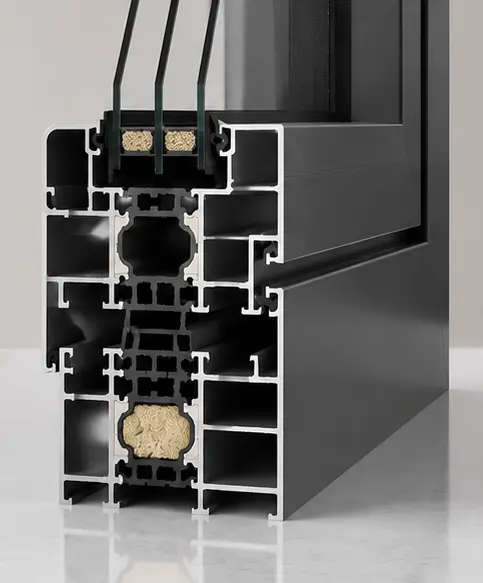
For thermal-break sections, assess the completed inner and outer shell assembly before confirming the mitered corner. Cutting, alignment, corner hardware and the relevant sealing details need to work together. Agree the fabrication route, including any specialist partner operations, before production.
Design the screw boss around the selected fastener
An extruded open screw port can simplify a butt joint, but its diameter, opening, wall support and engagement length must match the intended screw. The design must also allow the mating part and tool to reach the connection.
Confirm whether the joint uses a tapped hole, thread-forming screw or another arrangement. Define tightening torque and the required connection performance, then verify representative assemblies. A universal angular closure rule for the screw port cannot replace this review. Avoid assuming that a screw which can be driven into a sample will remain reliable under service loads.
Check T-slot compatibility in detail
A nominal framing size does not establish compatibility with every nut or bracket sold for that size. Compare the slot mouth, lip thickness, undercut cavity and contact surfaces with the actual connector. Finishing allowances and burrs can also affect insertion and clamping.
External brackets can simplify assembly and may avoid drilling where the chosen system permits it. Internal anchors or hidden connectors can require holes or access machining. Record those operations on the component drawing instead of leaving them to the installer.
Trial interlocking parts as a pair
Male and female sections should be evaluated together during trial production. Agree whether the connection needs sliding clearance, an interference fit or elastic snap engagement. Check insertion force, retention and the ability to remove a serviceable component where required.
Use representative finished samples when coating affects the contact surfaces. Verify the intended assembly length and conditions: a short sample that fits easily may not reveal the friction or straightness issues encountered in a longer assembly.
Approve the complete connection
Before release, record the profile revision, hardware reference, critical fits, machining details and inspection method. Include any required corner strength, pull-out or assembly tests in the project specification. Retaining a reference assembly helps production and quality teams check the same requirements.
Frequently asked questions
Can Guantian supply matching corner cleats?
Yes. We can extrude and cut matching aluminum cleat profiles or coordinate suitable sourced corner keys, then check their fit with the frame. Confirm material, dimensions and quantity for the order.
Can we finalize the joint after the extrusion die is made?
It is better to choose the connection first. A later hardware change may require a different cavity, screw port or slot and can lead to tooling changes.
Should the fit be checked before or after finishing?
Check the condition that represents the final assembly. If the finish reaches mating surfaces, include that finish in sample approval and allowance calculations.
Share your frame assembly method, mating hardware and section drawings through WhatsApp or the inquiry form. Our engineers will review the connection features and fabrication route.