

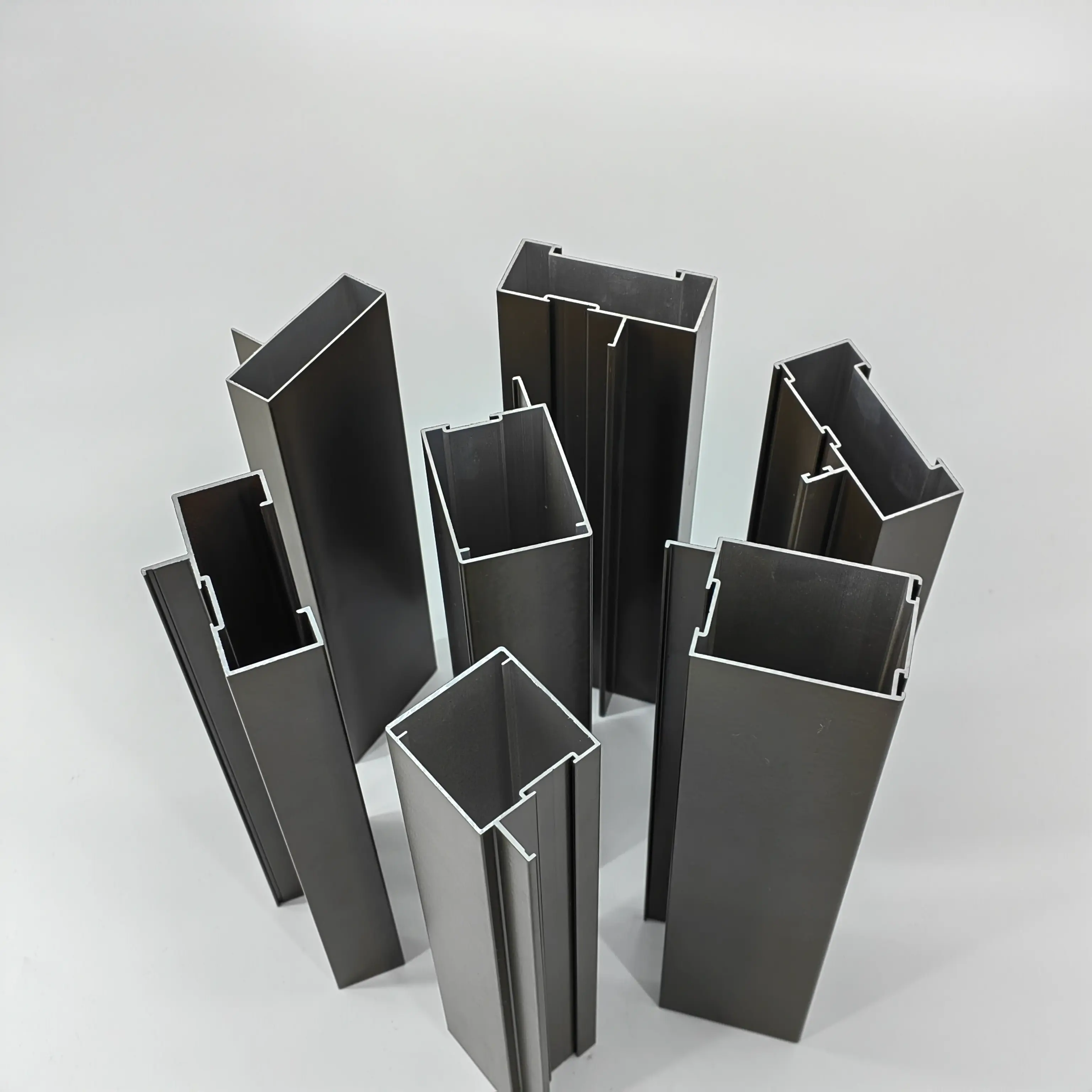
Define the load and assembly before choosing a wall
Begin with the span, support positions, load direction, allowable deflection and connection details. A profile can satisfy a strength requirement yet deflect too much in service. Local buckling, impact, fastener pull-out and the behavior of the complete assembly may also control the design.
Thickness changes affect weight per meter, cooling, extrusion speed and subsequent operations. Removing unnecessary metal can reduce material use, while making walls excessively thin can increase manufacturing difficulty. Compare the finished component and production yield rather than assuming that the lowest theoretical weight always gives the lowest cost.
Use preliminary thickness ranges for discussion
Guantian's preliminary planning ranges below relate section size and alloy to an initial wall-thickness review on its 800–1,500 metric-ton lines. CCD means circumscribing circle diameter: the diameter of the smallest circle enclosing the section. It is not necessarily the same as profile width.
These figures are preliminary manufacturing guidance, not guaranteed limits or structural design values. Cavities, unsupported features, tolerances, finish and the complete section can change the feasible range. Confirm the alloy, temper and final drawing with engineering before tooling.
| CCD | 6063-T5: preliminary minimum | 6063-T5: planning range | 6061-T6: preliminary minimum | 6061-T6: planning range |
|---|---|---|---|---|
| Below 50 mm | 0.8–1.0 mm | 1.1–1.5 mm | 1.2–1.4 mm | 1.5–2.2 mm |
| 50–120 mm | 1.1–1.3 mm | 1.4–2.0 mm | 1.5–1.8 mm | 2.0–3.0 mm |
| Over 120 and up to 220 mm | 1.4–1.8 mm | 1.8–2.8 mm | 2.0–2.5 mm | 2.5–4.5 mm |
Improve section geometry before adding metal everywhere
Moving material farther from the bending axis can improve bending stiffness efficiently. Depending on the constraints, a deeper hollow section or a better-positioned web may be more effective than thickening every wall. The designer still needs to assess the actual geometry and loading.
The familiar formula I = bh³/12 describes the second moment of area of a solid rectangle about its centroidal axis. It is not a general formula for a hollow or multi-chamber extrusion. Use section-property calculations for the real profile, followed by the required structural and connection checks.
Balance walls and smooth the transitions
Large differences between adjacent walls can complicate metal flow, straightening and surface control. Heavy internal junctions behind a decorative face can also make longitudinal surface variation more noticeable. Review these junctions while the die design can still be adjusted.
Aim for reasonably balanced walls and smooth transitions where the function allows. Fillets, webs and ribs can improve the design, but their dimensions must suit the section. A fixed rib-to-wall ratio or corner radius should not be applied to every profile without reviewing flow, die strength and appearance.
Put extra material where fabrication needs it
A wall intended only for a punched opening may not need the same thickness as a threaded fastening area. A local screw boss, reinforced strip or separate nut can provide the required connection without thickening the entire section.
For tapped or thread-forming connections, confirm screw type, engagement length, tightening torque and required pull-out resistance. M5 or M6 designation alone does not determine a safe wall thickness. Review drilling access, burr control and any masking or finishing allowance that affects assembly.
Validate the finished section
The trial should check wall distribution, straightness, visible faces and fit with mating parts. Where performance depends on the assembled section, agree the relevant component tests with the customer. Changes to thickness or ribs should be recorded on a controlled drawing revision before production approval.
Very thin architectural features require particular review for manufacturing stability and the applicable product requirements. The engineering discussion should identify a practical section, not merely confirm whether a die can produce an isolated thin wall.
Frequently asked questions
Does doubling wall thickness double strength?
Not as a general rule. The outcome depends on the section, load, failure mode and connections. Review strength, stiffness and local features separately.
Can a profile be designed below the preliminary minimum ranges?
Some sections may be feasible, while others need larger walls. Send the complete section and requirements for a specific review; the table is not a universal production guarantee.
Can local screw bosses help control weight?
They can concentrate material at a connection, but the boss and fastener need to be designed and tested together. The rest of the section must still satisfy its own requirements.
Send your CAD section, load scenario, mating parts and target weight per meter. Our engineering team will review the wall layout and practical manufacturing options.