
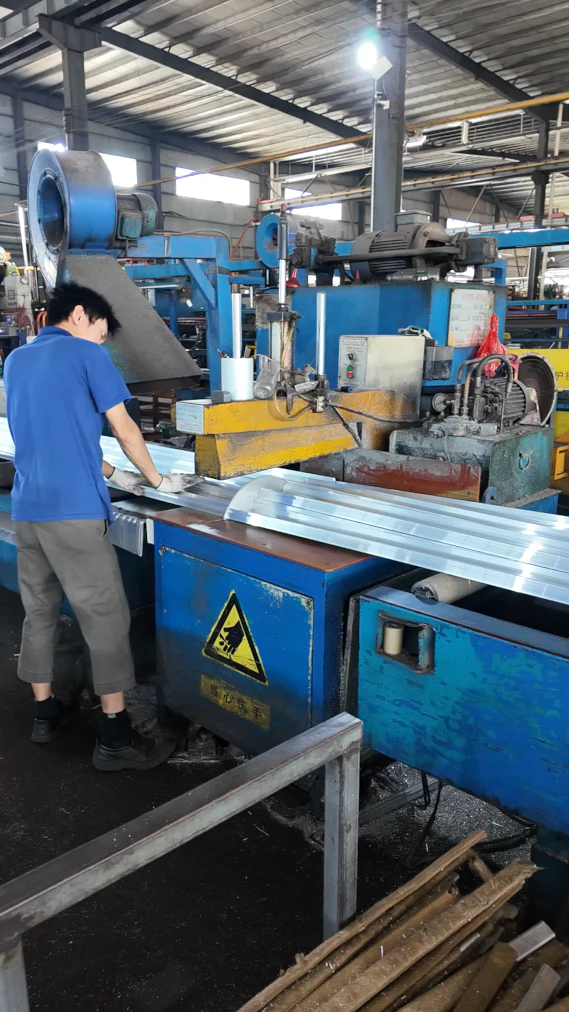
Understand the manufacturing scope
Guantian's Sanshui plant operates 7 extrusion lines from 800T to 1500T and 2 in-house powder-coating and wood-grain lines. Its coordinated in-house operations include thermal-break assembly, straight cut-to-length work and mechanical punching. These capabilities allow extrusion and suitable repeat fabrication to be planned together.
Specialist CNC machining, including suitable 3-axis or 4-axis work, drilling and tapping, as well as specialist 45-degree miter cutting, anodizing and electrophoresis, can be coordinated with qualified partners according to the project. The quotation should identify the agreed route. Guantian coordinates final inspection against the approved requirements before shipment.
Punching and CNC machining compared
| Decision point | Mechanical punching | CNC machining |
|---|---|---|
| Tooling and setup | A dedicated punch die may be needed; simple project examples are approximately USD 150–600. | No extrusion-specific punch die is needed, but programming, fixtures and setup can carry charges. |
| Production rhythm | Repeat strokes can be very fast; simple examples may take 1–3 seconds per stroke, excluding handling. | Cycle time depends on toolpaths, features, tool changes and the number of setups. |
| Typical operations | Repeated through-holes, slots and suitable thin-wall features. | Pockets, countersinks, complex hole patterns, threads and more demanding machined faces. |
| Illustrative positional tolerance | Approximately ±0.15–0.30 mm on suitable work. | Approximately ±0.02–0.05 mm on suitable features and setups. |
| Volume considerations | Often economical for repeated batches of 1,000–2,000 pieces or more. | Useful for prototypes, lower volumes and features that need flexible programming. |
The tolerance ranges are examples for quotation discussion, not blanket capabilities across an entire profile. Part length, wall thickness, clamping, hole position, datum choice and measurement method all affect the result. Punching thin walls around 3 mm or less may be suitable for some sections; harder material, unsupported walls or demanding edge quality can require another route.
Specify each thread, such as M3–M12 where appropriate, rather than simply asking for tapped holes. State thread depth, access, torque requirements and whether the thread is inspected with a gauge. A CNC setup that holds a short rigid part accurately may not deliver the same tolerance on a long flexible extrusion without additional support.
Should fabrication come before finishing?
Cutting after coating can protect the appearance of long visible faces and is practical when cut ends are hidden in the assembly. It leaves bare cut surfaces unless another treatment is specified. Machining before finishing is useful when the machined or exposed ends also need the chosen finish, but the coating allowance must then be included in the dimensions.
Threaded holes, close-fitting bores and electrical contact areas may need masking or a specifically agreed post-finish operation. Do not assume that one oversize tap or a single dimensional offset suits every coating. Identify visible A-surfaces and functional faces on the drawing, and approve a finished sample of the complete sequence.
Example: fabricated flow-rack guide rails
For an industrial rail project, the work can be divided into extrusion, controlled straight cutting, repeated punched mounting slots, swarf removal and partner anodizing. A fixture or stop gauge keeps the hole pattern referenced to the agreed datum. A roller or slider trial checks the functional interface in addition to dimensional inspection.
Deburring and cleaning are part of the component specification. Burrs at a punched opening can interfere with a slider; chips trapped in a cavity can emerge later on the customer's line. Confirm the required edge condition, cleaning method and inspection frequency, then pack the pieces so that machined faces and finished edges cannot damage one another.
How per-piece cost is built
A useful quotation separates metal weight, cutting allowance, fabrication, surface finishing and packaging. A planning allowance for cutting losses may be around 3–6% on some orders, but the actual allowance follows the nesting plan, saw kerf and end trimming. Optimizing the extrusion length can save more than negotiating a small change in the processing rate.
An extruded C-shaped screw port can sometimes reduce later machining, provided the fastening design and strength requirements permit it. Discuss this during die design, before the profile geometry is fixed. Features that simplify fabrication should still be validated in the intended assembly.
Frequently asked questions
What cut-length tolerances can we request?
Reported general examples include ±0.5 mm for suitable lengths below 2,000 mm and ±1.0 mm for lengths from 2,000 to 6,000 mm. Tighter or different requirements need drawing review and written confirmation, including how the length is measured.
Can you quote a finished part instead of a price per ton?
Yes. Provide the extrusion section, fabrication drawing, quantity, finish and packing requirements. We can agree an itemized or per-piece quotation for the specified supply scope.
Can we start with a small machined sample batch?
A sample or pilot batch can help confirm datums, hole positions, finish and assembly before repeat production. Setup costs and the pilot schedule are confirmed separately from the bulk order.
Send a complete fabrication drawing
Share the section drawing and fabrication print, including cut lengths, hole locations, datums, threads, tolerances and visible surfaces. Add the order quantity and finish. Contact us on WhatsApp to compare punching and CNC routes for your component.