

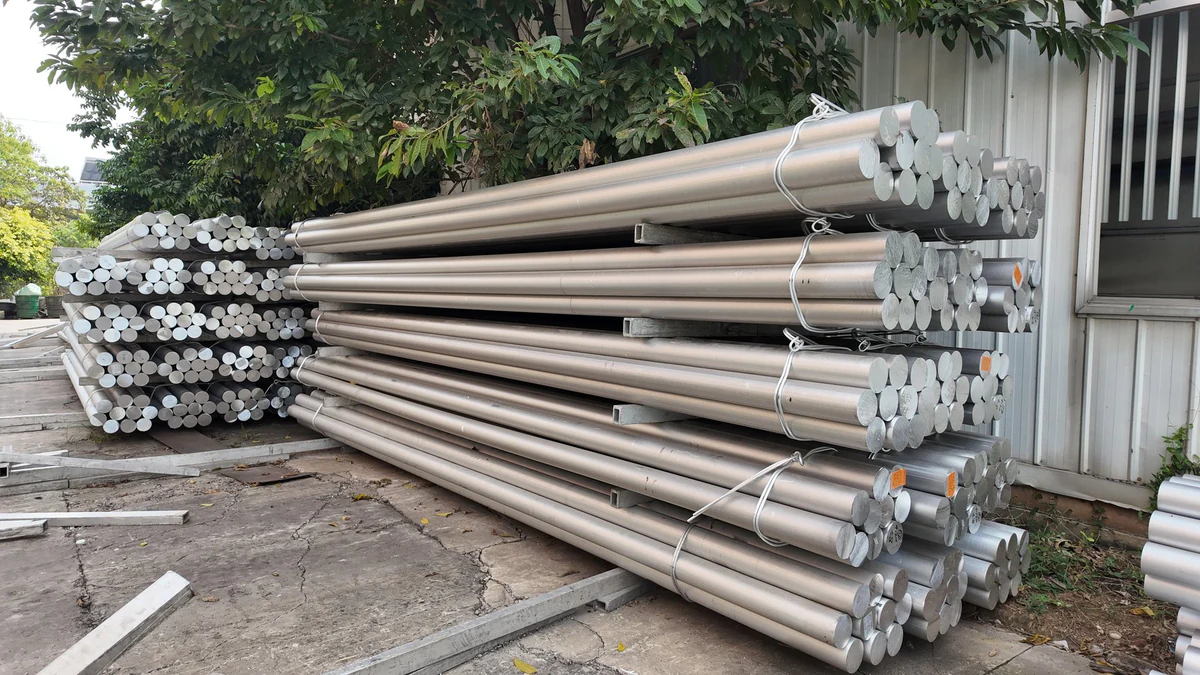
Where production scrap comes from
Extrusion produces material that does not become a delivered profile: press butts, head and tail offcuts, trial bars, rejected sections, sawing chips and punching slugs. Finishing and assembly can also produce coated offcuts or pieces containing thermal-break strips.
These streams differ in alloy and condition. Sorting them at the workshop makes the next recovery stage easier and helps avoid mixing clean metal with coatings, polymer strips, steel fasteners or general waste. Guantian separates clean recoverable extrusion scrap by alloy and sends it to licensed remelting businesses.
Five stages from workshop scrap to new billet
Recovery begins at the machine and continues through the recycler’s treatment and casting process. The route is recorded separately from the purchase of new billets.
- 1. Collection: gather press butts, trial profiles, cut ends, chips and punching scrap at the relevant workshop stations. Keep coated and composite pieces in their designated streams.
- 2. Sorting: separate alloys such as 6063 and 6061, and keep clean bare aluminum apart from coated profiles or thermal-break assemblies. Prevent unrelated material from entering the clean-metal bins.
- 3. Weighing and handover: weigh the segregated material and transfer it to licensed recyclers. Guantian retains handover records through its warehouse and finance teams so quantities and recipients can be traced.
- 4. Recycler treatment: the receiving plant selects suitable pretreatment, removes coatings or other contaminants where needed, and remelts the prepared material. Composition analysis, controlled blending and melt treatment are used to meet the intended alloy specification.
- 5. Casting and preparation: suitable melt is cast into billet, followed by the required homogenization treatment and checks before extrusion use. The resulting billet must meet its composition and quality requirements, regardless of its metal source.
Separate material origin from material quality
Primary metal and recycled metal can both be used to make specified aluminum alloys. The relevant production controls include composition, melt cleanliness, billet condition and process consistency. Material origin alone does not guarantee a flawless finish or disqualify a billet from demanding applications.
Guantian’s standard sourcing policy uses primary A00-based homogenized billets with incoming material documentation. Where recycled content is required, it should be arranged as a defined sourcing requirement, with evidence tied to the supplied batch.
| Sourcing route | What to agree | What the records establish |
|---|---|---|
| Standard primary A00-based homogenized billet | Alloy, temper, composition and finished-profile acceptance criteria | Material and batch information for the supplied order |
| Specified recycled-content billet | Required recycled content, sourcing method, traceability and the same technical acceptance criteria | The stated recycled-content basis and its connection to the order |
| Workshop scrap recovery | Sorting, weighing and transfer to an appropriate recycler | How process scrap is managed; not the recycled content of outgoing profiles |
Make environmental claims match the evidence
Aluminum can be recycled repeatedly, and industry data show that recycling uses substantially less energy than primary production. This industry comparison is not a measured carbon footprint for a specific Guantian order. Actual product claims require a stated calculation boundary and supporting data.
If your project specifies recycled content or a product carbon footprint, identify the required documentation before purchasing. Agree how material origin, batch traceability and the environmental declaration will be demonstrated. Do not infer a recycled-content percentage from the factory’s scrap recovery practice or describe all recycled-content material as having the same carbon footprint.
Frequently asked questions
Does recovering factory scrap mean the profiles we buy contain recycled metal?
No. Scrap recovery records describe the outgoing material stream. Recycled content describes the metal used in the purchased product and requires its own sourcing and documentation basis.
Can thermal-break profile offcuts be recycled?
Yes. They are collected separately so a suitable recycler can separate the aluminum from the insulating strips and other components before remelting.
Can we request recycled-content billets?
Yes. Tell us the required content and documentation when you inquire. Sourcing availability, batch traceability and the finished-profile requirements must be confirmed for the contract.
Contact our team through WhatsApp with your alloy, recycled-content and documentation requirements so we can review a suitable sourcing route.